
Author: Anila B. Elliott, MD - C.S. Mott Children’s Hospital - University of Michigan
A 6-week-old infant presents with poor feeding, tachypnea, and a systolic murmur consistent with mitral regurgitation. Echocardiography reveals a dilated and poorly contractile left ventricle. Pulsed-wave doppler demonstrates retrograde diastolic flow from the left main coronary artery into the main pulmonary artery with a dilated, collateralized right coronary artery. The infant is scheduled for urgent surgical repair. Which of the following intraoperative strategies is MOST LIKELY to worsen myocardial ischemia in this patient?
EXPLANATION
Anomalous origin of the left coronary artery from the pulmonary artery (ALCAPA), first described by Bland, White and Garland in 1933, occurs when the left main coronary artery arises from the pulmonary artery instead of the aorta. 1,2 In utero, pulmonary artery pressure equals systemic pressure, so myocardial perfusion is preserved. Postnatally, as pulmonary vascular resistance falls, disease progresses through three phases related to the changing neonatal and infant physiology (see Table 1).3 Initially, there is usually physiologic compensation due to elevated pulmonary vascular resistance and fetal hemoglobin to allow for adequate oxygen delivery. As the PVR drops and there is a physiologic anemia, patients often experience decompensation as coronary perfusion drops, typically causing anterolateral ischemia and progressive LV dysfunction. Over time, there is collateralization of the RCA. Depending on the extent of collateralization, some patients can make it to adolescence or even adulthood without significant symptoms. Patients with ALCAPA undetected in infancy usually present with a murmur from mitral regurgitation, cardiomegaly, abnormalities in ECG, exertional angina, or even present with sudden cardiac death. Those who do not have a robust network of collaterals may have poorly or unevenly distributed vessels that leave the left ventricle at risk for regional ischemia. Another concern is maldistributed collateral flow, which can create a functional left-to-right shunt and subsequent coronary steal. In these patients, RCA-derived flow runs off preferentially into the low-pressure pulmonary artery, rather than perfusing the ischemic myocardium. 3
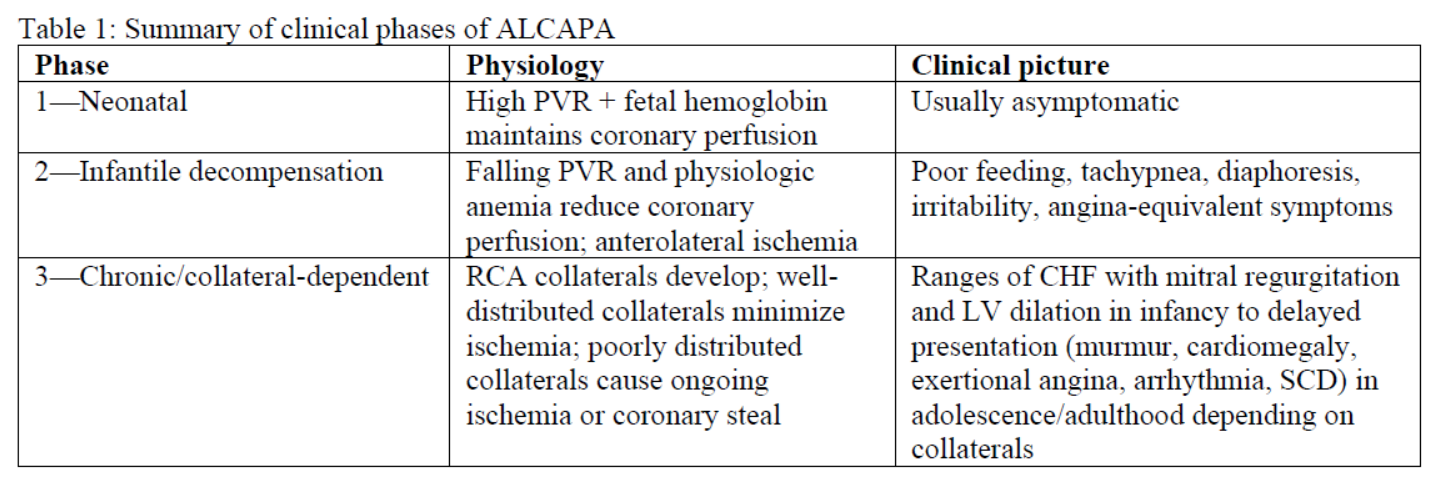
Diagnosis is confirmed with echocardiography, where pulsed wave doppler shows retrograde diastolic flow from the anomalous left coronary artery into the pulmonary artery, and the RCA is often dilated from chronic collateral flow.3
Because coronary perfusion depends on the pressure gradient between the RCA via collaterals and the pulmonary artery, anything that decreases PVR or pulmonary artery pressure can widen this gradient and worsen coronary steal.3 Anesthetic management goals are to maintain systemic vascular resistance (answer choice D) and PVR in order to maintain perfusion. Thus, hyperventilation to a PaCO2 of 30mmHg (answer choice B) would be detrimental, and is therefore the correct answer. Inotropes, such as epinephrine, should be also used cautiously in ALCAPA, as they can cause tachycardia and increase myocardial oxygen demand. 4 However, this effect is dose-dependent and can be minimized at low doses. An FiO2 of 21% (answer choice C) helps to maintain PVR, as oxygen is a pulmonary vasodilator and can therefore drop PVR.
Surgical treatment involves reestablishing a dual coronary artery system. Direct reimplantation of the anomalous coronary artery onto the aorta is considered the gold-standard technique as it restores normal coronary anatomy and blood flow and has been shown to be independently associated with superior long-term patency and outcomes.3 Other treatment options include transpulmonary baffling (Takeuchi procedure), which involves an intrapulmonary tunnel connecting the aortic root to the anomalous coronary ostium. After repair, LV function typically improves over months to a year following the repair. Younger patients tend to recover ventricular function more quickly, so earlier repair is ideal.
Anomalous origin of the right coronary artery from the pulmonary artery (ARCAPA) is rarer and generally does not have the same associated ischemia due to the lower pressure right ventricle. 1
REFERENCES
1. Hauser M. Congenital anomalies of the coronary arteries. Heart. 2005;91(9):1240-1245. doi:10.1136/hrt.2004.057299
2. Silva A, Baptista MJ, Araújo E. Congenital anomalies of the coronary arteries. Anomalias congénitas das artérias coronárias. Rev Port Cardiol (Engl Ed). 2018;37(4):341-350. doi:10.1016/j.repc.2017.09.015
3. Blickenstaff EA, Smith SD, Cetta F, Connolly HM, Majdalany DS. Anomalous Left Coronary Artery from the Pulmonary Artery: How to Diagnose and Treat. J Pers Med. 2023;13(11):1561. Published 2023 Oct 31. doi:10.3390/jpm13111561
4. Fahy CJ, Ing RJ, Kern FH, O'Hare B, Redmond JM, Jaggers J. The anesthetic management and physiologic implications in infants with anomalous left coronary artery arising from the pulmonary artery. J Cardiothorac Vasc Anesth. 2012;26(2):286-290. doi:10.1053/j.jvca.2011.01.017