
Authors: Manal Mirreh, MD AND Asif Padiyath, MBBS - Children’s Hospital of Philadelphia
A 6-year-old male with no medical history presents with progressive dyspnea and is found to be hypoxic to 88% on room air, which improves to 98% on 2L nasal cannula.
Exam reveals jugular venous distention, a normal S1 with a prominent, single-sounding P2 component of S2, clear lungs, and his liver edge is palpable 4 cm below the costal margin. Vital signs are normal.
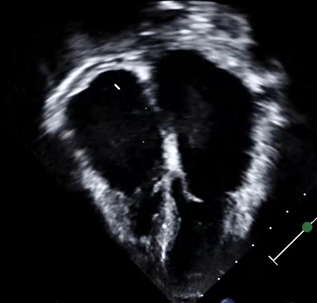
Laboratory evaluation is notable for an NT-proBNP of 2,890 pg/mL. Chest radiograph reveals significant cardiomegaly. A representative echocardiographic image is shown below.
Cardiac catheterization is performed and is notable for:
• Right ventricular pressure: 66/16 mmHg
• Left ventricular pressure: 91/23 mmHg
• Pulmonary vascular resistance (PVRi): 6 U ⋅ m²
• RV pressure tracing demonstrates a dip and plateau (square root) pattern
Which of the following is the next best step in management?
EXPLANATION
The clinical presentation with bi-atrial enlargement on echocardiogram, elevated NT-proBNP, and catheterization showing elevated end-diastolic pressures confirms advanced restrictive physiology with heart failure. Children with restrictive cardiomyopathy (RCM) have stiff, poorly compliant ventricles and rely on high filling pressures to maintain cardiac output given a relatively fixed stroke volume from impaired diastolic filling; they may also be heart rate–dependent to preserve cardiac output.
Pediatric RCM carries an extremely poor prognosis, with more than half of children dying or requiring transplantation within 2 years of diagnosis. Transplant-free survival is only 48% at 1 year, 34% at 2 years, and 22% at 5 years for isolated RCM. Cardiac transplantation (Answer C) remains the preferred treatment offering long-term survival.1 AHA guidelines specifically note that progressive pulmonary hypertension is associated with poor outcomes and should inform the timing of transplant listing. All children with RCM should undergo serial monitoring of pulmonary vascular resistance, and any significant finding should prompt consideration of transplant evaluation. This patient's PVRi of 6 Wood units·m² represents significant pulmonary hypertension requiring urgent evaluation, as delays risk the development of irreversible pulmonary vascular disease that would preclude isolated heart transplantation.1 Early referral before hemodynamic decompensation is associated with improved survival in the modern era (80% vs. 38% in contemporary vs. historical cohorts).2 Elevated PVR can be an absolute or relative contraindication to isolated heart transplantation, sometimes prompting consideration of combined heart-lung transplant due to the risk of postoperative RV failure. However, isolated heart transplant offers better long-term survival, and PVR elevation from left heart disease usually normalizes afterward.3
VAD therapy (Answer A) can be implemented if the patient were to decompensate, but is not the preferred bridge to transplantation in pediatric RCM. The restrictive pathophysiology produces compromised diastolic filling and small ventricular cavities that impair VAD function and risk inflow cannula obstruction. 1 National database studies show only about 4.5% of children with RCM listed for transplant receive VAD support, compared to 24% of those with dilated cardiomyopathy.1 Although novel cannulation strategies (transseptal left atrium-to-aorta, atrial cannulation, or biventricular support) have been attempted, outcomes remain poor: cerebrovascular accidents occur in 31.8%, pump thrombosis in 29.5%, and major bleeding in 25%.4 VAD support achieves only 59.1% survival to transplantation in RCM, with significantly higher mortality than in dilated cardiomyopathy (35.8% vs. 17.0% at 1 year).4 ACTION registry data show that all deaths among VAD-supported patients in this cohort occurred in the hypotrophic, rather than restrictive, cardiomyopathy subgroup; these patients uniformly required biventricular support and experienced adverse events, with deaths attributed to inadequate support, infection, and multi-organ failure. No deaths were reported among the RCM patients in this series.5
Because RCM patients depend on heart rate to help preserve cardiac output in the setting of a fixed, restricted stroke volume, beta blockade (Answer B) removes this compensatory mechanism and risks acutely reducing cardiac output and precipitating hemodynamic decompensation. Beta blockers have no established role in acute management of restrictive physiology heart failure and should be avoided.
Pulmonary vasodilator therapy is being used in some centers as adjuncts before transplantation to optimize PVR. However, guidelines do not support routine use of pulmonary vasodilators in this setting due to limited evidence and risk of clinical worsening from increased transpulmonary blood flow and left atrial hypertension leading to pulmonary edema without significant improvement in cardiac output, as the main physiologic issue in patients with RCM is restriction to filling.
REFERENCES
1. Bogle C, Colan SD, Miyamoto SD, et al. Treatment strategies for cardiomyopathy in children: a scientific statement from the American Heart Association. Circulation. 2023;148(2):174-195.
2. Anderson HN, Cetta F, Driscoll DJ, et al. Idiopathic restrictive cardiomyopathy in children and young adults. Am J Cardiol. 2018;121(10):1266-1270. doi:10.1016/j.amjcard.2018.01.045
3. Hopper RK, Hansmann G, Hollander SA, et al; on behalf of the American Heart Association Council on Cardiopulmonary, Critical Care, Perioperative & Resuscitation; Council on Clinical Cardiology; and Council on Cardiovascular Stroke Nursing. Clinical management and transplant considerations in pediatric pulmonary hypertension due to left heart disease: a scientific statement from the American Heart Association. Circ Heart Fail. 2025;18:98-109. doi:10.1161/HHF.0000000000000086
4. Rohde S, Miera O, Sandica E, et al. Ventricular assist device support in paediatric patients with restrictive cardiomyopathy-clinical outcomes and haemodynamics. Eur J Cardiothorac Surg. 2024;66(2):ezae277. doi:10.1093/ejcts/ezae277
5. Mokshagundam D, Shezad MF, Conway J, et al. Ventricular assist device use in pediatric restrictive and hypertrophic cardiomyopathy: an ACTION registry analysis. ASAIO J. 2025;72(1):65-70. doi:10.1097/MAT.0000000000002464