Author: Anila B. Elliott, MD - University of Michigan - C.S. Mott Children’s Hospital
A 17-year-old patient status post HeartMate III ventricular assist device for failing Fontan physiology and tachyarrhythmias presents for dental extractions during their transplant work-up. At the end of the procedure, the patient is noted to go into a tachyarrhythmia with a heart rate of 125 beats per minute. Their doppler pressure is stable despite the change in rhythm. Because the patient is still sedated their neurological status is unable to be adequately assessed. What is the NEXT BEST course of action?
EXPLANATION
Ventricular assist devices (VAD) are increasingly utilized in pediatric and adolescent patients with advanced heart failure, due to advancements in palliative therapies leading to longer survival, limited organ availability, and ongoing advancements in VAD technology and management. These patients, especially those with complex congenital cardiac anatomy, present unique perioperative challenges as they present for subsequent cardiac and non-cardiac procedures1,2.
There are two main groups of devices used in the congenital cardiac patient population: pulsatile-flow (PF) and continuous-flow (CF) devices. Younger patients typically receive PF devices, such as the Berlin EXCOR. In adolescent patients, the total artificial heart (SynCardia) may be another pulsatile-flow option. There is increasing use of continuous-flow devices, such as the HeartMate III, in other adolescents and young adults. An analysis of the Pediatric Interagency Registry for Mechanical Support (Pedimacs) showed that, although the children with congenital heart disease in general had worse outcomes, they had better survival with an implanted CF device3.
For CF VADs, adequate preload is essential for pump inflow and cardiac output. Low preload reduces pump flow and can lead to suction events, while high afterload also impairs forward flow. Changes in preload and afterload should be treated with fluids and vasoactive drugs, as opposed to changing pump settings2,4.
Clinically, patients with continuous-flow devices may lack palpable peripheral pulses. Doppler pressure measurements are reliable, while automated blood pressure measurements work only ~50% of the time4.
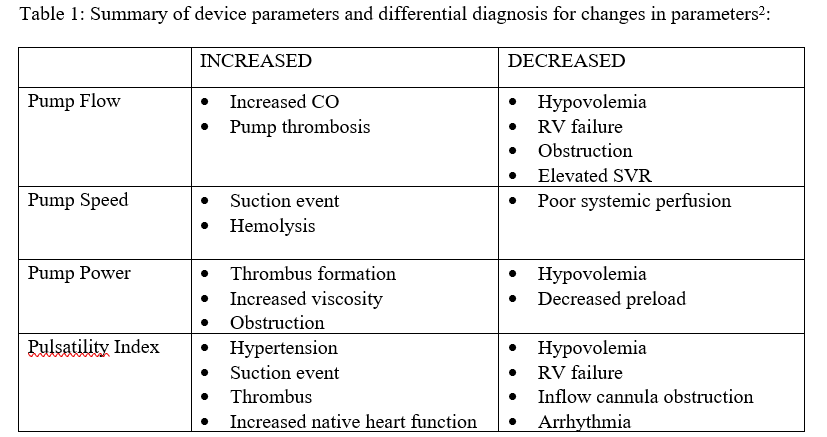
Tachyarrhythmias are common in heart failure, with or without mechanical circulatory support, and can impact filling. In single ventricle patients supported by a VAD, as long as their pulmonary blood flow is maintained, their systemic blood flow is maintained, so these arrhythmias can be well tolerated. For arrhythmias with preserved perfusion, urgent interventions with cardioversion or anti-arrhythmics are not required due to the nature of the continuous-flow device. Mechanical troubleshooting of the device should be prioritized before electrical or pharmacological interventions 4,5 Since the above patient had stable doppler pressure, answer choice C, checking the device function, is the most appropriate next step. Common device parameters, their alterations and differential diagnoses are listed in Table 1 below.
According to American Heart Association guidance, stepwise management for tachyarrhythmias in a patient with a continuous-flow VAD includes1:
1. Check device function
a. Ensure driveline connections are intact
b. Ensure adequate battery/power source
c. Check for device alarms and ensure appropriate settings
2. Check for clinical signs of decompensation
a. Check doppler pressure
b. Assess mental status
c. If there is clinical deterioration with decreased perfusion, initiate advanced therapies per ACLS and PALS
d. Chest compressions are generally reserved for true circulatory collapse or cardiac arrest due to the risk of damaging the device/hardware. Chest compressions should not be performed in patients with SynCardia total artificial hearts
 REFERENCES
1. Peberdy MA, Gluck JA, Ornato JP, et al. Cardiopulmonary Resuscitation in Adults and Children With Mechanical Circulatory Support: A Scientific Statement From the American Heart Association. Circulation. 2017;135(24):e1115-e1134. doi:10.1161/CIR.0000000000000504
2. Falland R, Allen SJ. Perioperative management of patients with a ventricular assist device undergoing non-cardiac surgery. BJA Educ. 2023;23(10):406-413. doi:10.1016/j.bjae.2023.06.003
3. Peng DM, Koehl DA, Cantor RS, et al. Outcomes of children with congenital heart disease implanted with ventricular assist devices: An analysis of the Pediatric Interagency Registry for Mechanical Circulatory Support (Pedimacs). J Heart Lung Transplant. 2019;38(4):420-430. doi:10.1016/j.healun.2018.10.008
4. Forshaw N, James I. Anaesthesia for children with left ventricular assist devices undergoing non-cardiac surgery. BJA Educ. 2018;18(12):371-376. doi:10.1016/j.bjae.2018.09.002
5. Adachi, I. Ventricular Assist Device Implantation for single ventricle. Operative Techniques in Thoracic and Cardiovascular Surgery. 2020; 25(2): 74-84. doi.10.1053/j.optechstcvs.2020.04.003