Author: Kaitlin M. Flannery, MD, MPH - Stanford University
A 15-year-old male (100 kg, BMI 33 kg/m2) with a history of tetralogy of Fallot repaired with a transannular patch presents for transcatheter pulmonary valve replacement. His medical history also includes trisomy 21 and obstructive sleep apnea, with noncompliance to CPAP therapy. The interventional team plans to use a vascular closure device instead of manual compression for femoral access-site hemostasis. Compared with manual compression alone, the use of a vascular closure device is MOST LIKELY to reduce which of the following?
EXPLANATION
Manual compression is the gold standard for achieving hemostasis after femoral vessel cannulation in the catheterization lab, whether for diagnostic or therapeutic interventions. However, this process is time-consuming and labor-intensive, often requiring pediatric patients to remain under general anesthesia or sedation due to discomfort. Additionally, after achieving hemostasis with manual compression, prolonged supine positioning, referred to as “flat time”, is necessary. Flat time is determined by the interventional cardiology team based on a variety of factors including arterial vs venous access, size of catheter utilized, and anticoagulation. Flat time following manual compression is generally four hours. This flat time can be particularly challenging for young patients, those with developmental disabilities, or individuals who are unable to tolerate the flat position (e.g. scoliosis, heart failure, obesity, obstructive sleep apnea). Achieving successful manual compression can also be difficult in cases of obesity, anticoagulation use, and with larger sheaths for interventional procedures.1 Pediatric access site complication rates range from 3 to 10%, according to several single-center studies, with most complications being transient pulse loss, thrombosis, hematoma and rebleeding.2
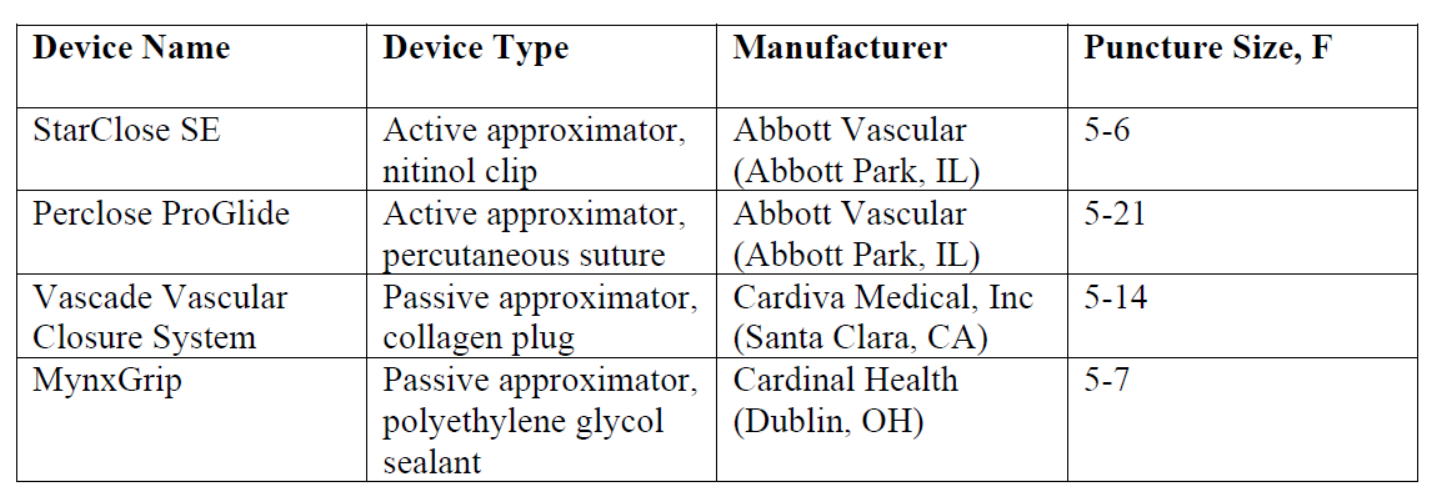
Vascular closure devices (VCDs) are designed to achieve hemostasis without the need for prolonged manual compression. The first device was introduced in the 1990s, and several more have since been developed and are frequently used in adults. VCDs are divided into two categories: active and passive approximators. Trials leading to FDA approval of these devices have not included pediatric patients, but they are increasingly being utilized off-label, particularly in teenagers. Active approximators close the opening created utilizing either sutures or clips, while passive approximators deploy a plug above the opening. The table below provides details on several VCDs.1
A systematic review of 34 randomized controlled trials comparing manual compression and VCDs in adults found a statistically significant reduction in median time to hemostasis, 17 minutes versus 3.7 minutes for diagnostic procedures, and 29.1 minutes versus 7.6 minutes for interventional procedures. The time to ambulation, defined as time from hemostasis to walking, was significantly shorter in patients with VCDs, 8 hours versus 3.5 hours. There was no significant difference in time to hospital discharge or access site complication rates.3 No trials have been sufficiently powered to detect a difference in access site infection or thrombosis with VCDs, which remain concerns frequently discussed in the literature.
In a 2018 study from Lurie Children’s Hospital, the use of the MynxGrip for hemostasis of 5 Fr femoral arterial access in pediatric patients undergoing neuro-endovascular procedures was retrospectively reviewed. The study evaluated 83 devices in 53 patients, with 83% being teenagers, and the youngest being six years old. Ultrasound was used to ensure common femoral artery diameter of > 4 mm and adequate subcutaneous space to avoid protrusion of sealant through the skin. One device placement was unsuccessful due to device balloon failure, and the decision was made to utilize manual compression instead of a second device. The hemostasis time using the MynxGrip was 5 minutes, compared to the institution’s manual compression time range of 12-45 minutes over the study period. There were no major complications immediately or at 8-week follow up, including significant bleeding, hematoma, pseudoaneurysm, or fistula. Importantly, 29 patients who underwent diagnostic studies returned within a month for therapeutic interventions, and in all but one case, access was reobtained in the same artery. Additional details regarding the case where access in the same artery was not possible were not provided. 4
The available literature indicates a significant reduction in time to hemostasis and ambulation with the use of VCDs for hemostasis. These would be clinically beneficial in the patient described above, who presents with concerns regarding his ability to tolerate prolonged post-procedure supine positioning without sedation. No differences have been shown in access site infection rates or time to hospital discharge.
REFERENCES
1. Noori VJ, Eldrup-Jorgensen J. A systematic review of vascular closure devices for femoral artery puncture sites. J Vasc Surg. 2018 Sep;68(3):887-99.
2. Praditukrit A, Wongwaitaweewong K, Sangsupawanich P, et al. Development of a pediatric vascular catheterization complication score (Ped-VCCScore) for predicting post-cardiac catheterization complications. PLoS One. 2025 Jun 2;20(6):e0325044.
3. Cox T, Blair L, Huntington C, Lincourt A, Sing R, Heniford BT. Systematic review of randomized controlled trials comparing manual compression to vascular closure devices for diagnostic and therapeutic arterial procedures. Surg Technol Int. 2015 Nov:27:32-44.
4. Shokuhfar T, Hurley MC, Al-Smadi A, et al. MynxGrip vascular closure device use in pediatric neurointerventional procedures. J Neurosurg Pediatr. 2018 May;21(5):466-70.